Caine’s Target Towline
The Caine MutinyCaine’s Target Towline is the line that broke during USS Caine’s target-towing operation, leaving the target lost and turning a piece of working equipment into the center of a dispute over seamanship, judgment, and responsibility. Its significance lies not only in its failure but in what followed: whether the loss was recoverable, what maneuver had caused it, and why Philip Francis Queeg did not acknowledge it when questioned. The line’s absence became evidence around which others tested the captain’s account, while Queeg later used the same incident to explain his troubles with ComServPac and to accuse John Stilwell of disloyalty.
Function and Failure
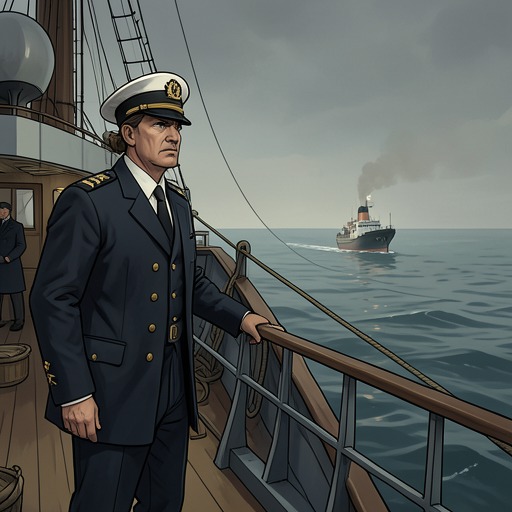
In ordinary use, the towline linked USS Caine to the target it was towing. Once the line parted, that practical connection was severed, and the target was lost. The available accounts establish the break and its consequence, but they do not settle in themselves exactly how the line parted. That uncertainty matters: the inquiry turns on the difference between a line that simply failed and a loss brought about by the ship’s maneuver.
The towline first becomes consequential through the response to its loss. Burt Gorton tells Queeg that he had seen a comparable line part during a shooting exercise with USS Moulton (DMS-21) in 1940. In that instance, the crew recovered it without difficulty in about half an hour. Gorton’s recollection does not prove that USS Caine could have recovered its own line under identical conditions, but it gives the comparison a concrete measure: a parted towline need not automatically mean an unrecoverable target. Gorton therefore identifies the possibility that Queeg overestimated the difficulty of recovery.
Recovery and Command Judgment
Queeg’s question to Gorton makes the towline’s loss a question about his own decision-making. After Gorton suggests that recovery might have been easier than Queeg believed, the captain asks why this information was not given to him when it could have influenced his command decision. The exchange shifts attention from the damaged equipment to the information available aboard ship: what the executive officer knew, when he knew it, and whether that knowledge could have changed the response.
The incident also reaches ComServPac as more than a report of lost equipment. Queeg is distressed that an official mailgram calls the operation a fiasco and asks whether he made any mistake. When Captain Grace questions him, he initially insists that he used standard rudder and appeals to his logs. Grace clarifies that he is asking not about the amount of rudder but about the extent of the turn, including whether Queeg came around in a complete circle and cut his own towline. The question puts the line’s break at the intersection of physical operation and command responsibility: a record of standard rudder, by itself, does not answer what course the ship took.
Inquiry and Evasion
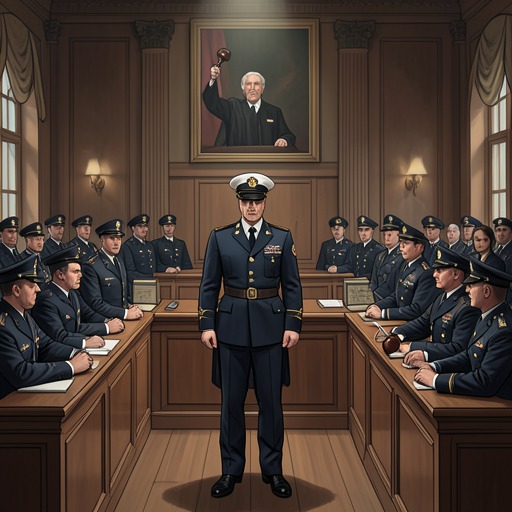
Queeg reacts to Grace’s direct question as a personal insult and says that, if he had cut the line, he should have recommended his own general court-martial. His response does not resolve whether the ship came around in a circle. Grace explains that the admiral has heard rumors about troublemakers aboard and connects the towline incident to other concerns: USS Caine’s earlier grounding, an effort to evade a grounding report, a report Grace calls a phony gun-deck job, and Queeg’s dispatch asking what to do after losing the target. In Grace’s account, the central failure was not simply losing the target; it was failing to make an obvious decision and accept responsibility for it.
The towline thus serves as a concrete point of contention within a broader examination of Queeg’s command. Gorton’s comparison raises the question of recoverability; Grace’s questioning raises the possibility that the ship’s own maneuver caused the break; and Queeg’s reliance on his logs and indignation leave the underlying issue contested in that exchange. The equipment failure cannot be separated from the different accounts of what happened around it.
Queeg’s Later Admission
Later, in the executive’s room, Queeg refers to the towline incident while confronting Steve Maryk over Maryk’s handling of Stilwell’s emergency leave. Queeg now says that the line had been cut, an acknowledgment Maryk finds startling because Queeg had not admitted this before. Queeg immediately makes the incident part of his case against Stilwell: he argues that the helmsman should have warned the commanding officer that the ship was in danger, and claims that Stilwell stayed silent because Queeg had reprimanded him earlier for being too fresh and making decisions at the helm.
This later account changes the towline’s role without settling the earlier question Grace asked. Queeg acknowledges that the line was cut, but the supplied exchange does not establish that he admits cutting it himself. Instead, he assigns blame to Stilwell and describes the silence as deliberate retaliation. The towline’s break consequently recurs as a disputed event: first a loss whose recoverability and cause are questioned, then an acknowledged fact enlisted in Queeg’s attack on a subordinate. Its narrative force comes from that shift. A severed working connection becomes the means by which the ship’s officers expose, contest, and redistribute responsibility.